DTU ELECTRO

Silicon carbide photonic integrated circuit training network

Illustration: AI-generated
AI-generated illustration of neon geometric circuits

Our overall goal is to build an innovative material platform, i.e. SiC for PIC, centered with chip-scale SiC-based OFC, which will represent a major contribution to several market applications, including optical communication, mid-infrared spectroscopy and quantum communications.

Project overview


SiCPIC will train 15 DC's to an outstanding level in both academic and industry R&D environments, where they can act as Europe’s future leaders within OFC technologies, provide a much-needed link between academia and SiCPIC industry, and make the new technology widely available through e.g. spin-out companies.


Full demonstration of these applications is included in the SiCPIC project.

key facts

  • Call: HORIZON-MSCA-2024-DN-01
  • Type of Action: HORIZON-TMA-MSCA-DN
  • Acronym: SiCPIC
  • Number: 101227010
  • Duration: 48 months
  • GA based on the: HE Unit MGA - Multi & Mono - 1.2
  • Estimated Project Cost: EURO 0.00 
  • Requested EU Contribution: EURO 4,306,626.00
  • Current Phase: Grant Management
  • Start Date: 01 Jan 2026

Work packages

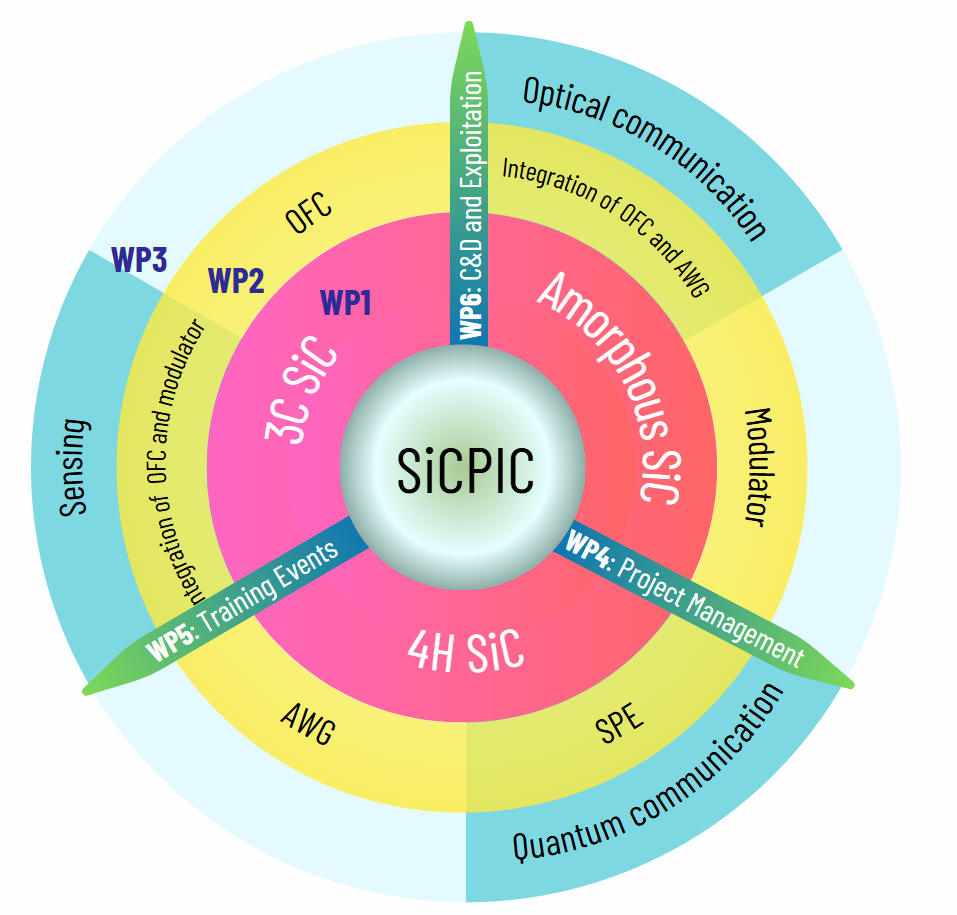
  • RO1: Achieve wafer scale 4’’ SiCOIstacks with low loss in SiClayer and uniform SiCthickness and smooth SiCtop surface. SiClayer loss in SiCOIis smaller than 0.1 dB/cm, thickness of SiClayer is 1μm and nonuniformity is +/-5%, surface roughness is lower than 0.5 nm.
  • RO2: Establish a metrology routine on a wafer level to validate the performance of the SiCOI stacks as applied in photonics.
  • RO3: Definition of an AI assisted analysis routine which links the SiCOI fabrication process and the metrology on a wafer level.
  • Lead: FAU
  • RO4: Achieve fully integrated SiCOI OFC in the lab. SiC waveguide loss is smaller than 0.5 dB/cm, Q of MRR>1M, coupling loss smaller than 3dB/facet, Octave soliton is achieved.
  • RO5: Achieve monolithically integrated SiCOI OFC with arrayed waveguide grating (AWG) working at telecommunication wavelength range.
  • RO6: Achieve scalable single photon emitters in SiC by using laser writing and integrate them in photonic devices.
  • RO7: Achieve monolithically integrated SiCOI OFC with modulators working at mid-infrared wavelength range around 2.4 μm to 3.0 μm and line spacing <1Ghz.
  • Lead: DTU
  • RO8: Implementation of SiCOI OFC source for mid-infrared spectroscopy for multi component trace gas detection.
  • RO9: Implementation of SiCOI source in quantum system.
  • RO10: Implementation of SiCOI OFC source in optical communication system
  • Lead: DTU
  • Objectives:
    • To ensure a smooth running of the project, including communication between the consortium and the EC, so that all knowledge is created, managed and disseminated in a coordinated and coherent manner and all training activities, financial and legal aspects, and other issues are managed transparently at a high standard;
    • To ensure that the EC requirements for communication and reporting are met.
  • Lead: DTU
  • Objectives: To complement the day-to-day training through research activities by
    • providing training through inter-disciplinary research courses relevant to the project;
    • train DCs in transferable/soft skills (entrepreneurship, business, IPR, management, leadership, scientific writing, communication, etc.)
  • Lead: POLITO
  • Objectives: Dissemination and exploitation of results and scientific advancements, as well as increasing awareness in the general public of the benefit and need for new researchers.
    • Promote two-way knowledge and data share and transfer between academic and non-academic partners;
    • Maximize industrial uptake of knowledge, to ensure value creation and commercial exploitation of R&D results;
    • Disseminate project concepts, ideas and results to the general public;
    • Identify, assess and protect all relevant project results.
  • Lead: CNRS
SiCPIC project illustration

doctoral candidates

SiCPIC will train 15 DCs to an outstanding level in both academic and industry R&D environments, where they can act as Europe’s future leaders within OFC technologies, providing a much-needed link between academia and SiCPIC industry, and making the new technology more widely available through e.g. spin-out companies.
AI-generated illustration of an abstract navy tech grid

Host institution: DTU

Project: PhD scholarship in Optical Frequency Combs for Spectroscopy

About: Paolo Leonelli received his Bachelor’s degree in Electromechanical Engineering from the Technological University of Panama, Panama City, Panama, in 2023 and his Master’s degree in Optics and Photonics from the Karlsruhe Institute of Technology (KIT), Karlsruhe, Germany, in 2025. During his master’s studies, his research focused on ultra-fast, high-resolution dual-comb ranging with extended unambiguity range for industrial metrology applications.

Project Objectives: Extending the wavelength range of OFC from telecommunication to middle infrared by using different mechanisms such as Raman scattering. Reducing the teeth spacing of OFC from dozens of GHz down to sub-GHz by integrating modulators. 

Expected Results: Demonstrating SiCOI OFC covering 2-3μm for middle-infrared spectroscopy and engineering the teeth spacing of OFC for good resolution. The best performance chip will be sent to WP3 for prototyping. 


partners

AI-generated illustration of an abstract neon photonic tech grid

Publications and Outreach

Funding

Flag of the European Union and text saying: 'Funded by the European Union'
This project has received funding from the European Union’s Horizon Europe’s Research and innovation Programmeunder the Marie Skłodowska-Curie Grant Agreement No. 101120353

News and events

Stay updated with our latest activities and upcoming events.

Stay tuned for updates on project milestones, research publications, conferences, and workshops and more. News and events will be posted here as the project progresses.

Contact

Project Coordinator

Haiyan Ou

Haiyan Ou Group leader, Professor Department of Electrical and Photonics Engineering